Views: 0 Author: Site Editor Publish Time: 2026-07-22 Origin: Site


Choosing a mooring configuration is never just a routine purchasing decision. It stands as a critical operational risk management issue. The setup you deploy directly dictates vessel safety, crew protection, and long-term operational resilience. Over recent years, maritime operations have shifted significantly from traditional wire ropes to high-modulus synthetics. This industry-wide evolution forced engineers and marine superintendents to fundamentally rethink elasticity and shock absorption. High-strength synthetics simply do not stretch like conventional materials.
This article provides a comprehensive technical framework for making the right choice. You will learn how to evaluate a tail-based system against a continuous single-line setup. We guide your selection based on specific vessel types, dynamic environmental conditions, and rigorous maritime compliance standards. By understanding the mechanical dynamics involved, operators can secure their fleets against unpredictable forces while streamlining routine deck operations.
Maritime mooring systems operate in highly volatile environments. They rarely experience static, predictable forces. Instead, they must constantly manage rapid energy spikes. We call these dynamic loads.
Wind gusts, tidal shifts, and hydrodynamic forces from passing vessels generate immense kinetic energy. The mooring system must absorb this energy safely. If it fails to yield and stretch, the structural integrity of deck fittings becomes compromised. In worst-case scenarios, the line parts entirely, creating a lethal snap-back zone on deck.
A Mooring Rope with Tails divides the physical labor into two specialized components. Each part handles a distinct mechanical task.
The tail serves one primary function: it acts as a massive shock absorber. It elongates under sudden stress, compensating entirely for the main line's rigid nature. Once the dynamic load passes, the tail retracts, returning the vessel to its original holding position.
A single-line setup relies on continuous, uniform material construction. There are no secondary attachments. The line stretches using its own inherent material properties.
Manufacturers typically construct these from mixed polyolefins, polyester blends, or specialized jackets over flexible cores. When a sudden wave hits the vessel, the elongation distributes evenly across the entire length of the deployed rope. This configuration requires a precise understanding of the distance between the ship's winch and the dock bollard. If the distance is too short, even a high-stretch single line cannot generate enough elongation to absorb the energy safely.
Heavy commercial shipping heavily favors tail-based configurations. We see this predominantly on Very Large Crude Carriers (VLCCs), massive container ships, and bulk carriers. These vessels frequently operate in exposed coastal terminals or high-swell ports where dynamic loading is severe.
The primary benefit lies in operational ergonomics. Decades ago, crews wrestled with heavily greased, dangerously heavy steel wires. Today, replacing those wires with high-modulus synthetics transforms deck safety. UHMWPE lines float on water and require significantly less physical exertion to handle. However, because these modern lines lack stretch, crews must append Mooring Tails to maintain safety margins.
Additionally, tails localize abrasion. The section of line wrapping around the shore bollard takes the most punishing friction. By using a tail, operators restrict this severe wear to a short, replaceable component. Replacing an 11-meter tail requires minimal downtime and protects the integrity of the expensive 200-meter main line.
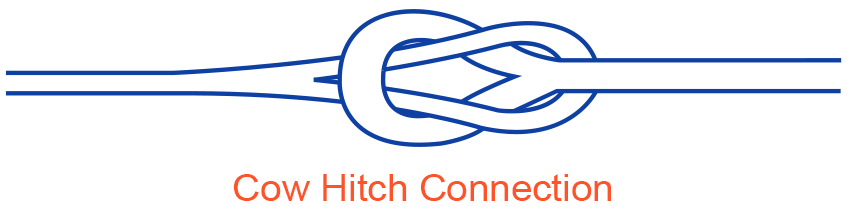
Despite their benefits, tail setups introduce inherent mechanical vulnerabilities. The system requires a connection point between the two ropes. Crews usually accomplish this using a specialized mooring shackle or a cow hitch knot.
This connection creates a localized wear zone. Friction between the two materials generates heat during cyclical loading. Furthermore, synthetic tails degrade much faster than their main line counterparts. They suffer from continuous UV exposure, saltwater ingress, and sheer physical exhaustion from constant stretching.
Not every vessel requires complex shock absorption systems. Smaller vessels, ferries, inland waterway barges, and ships operating exclusively in highly sheltered ports often perform better with a single-line setup. In these environments, wave-induced dynamic loading remains predictably minimal.
The greatest strength of a single-line configuration is structural simplicity. It eliminates connection hardware entirely. Fewer components mean fewer potential points of failure. Operators face zero risk of mismatched breaking strengths between a main line and a tail.
Furthermore, wear distribution happens uniformly. As the rope passes through fairleads and wraps around winch drums, the friction spreads across different sections over time. This makes visual inspections highly straightforward. Crews can apply standard retirement criteria without worrying about hidden connection-point fatigue.
To enhance durability in these setups, many operators deploy a Jacketed Mooring Rope. The tightly braided outer jacket provides formidable abrasion resistance against rusty chocks and rough bollards. It protects the load-bearing core entirely, functioning flawlessly without needing a separate sacrificial tail.
If operators attempt to use traditional high-stretch materials for heavy-duty applications, the resulting ropes become massive. A nylon single line capable of holding a VLCC would require an impractical diameter. It becomes bulky, heavy, and extremely difficult for crews to handle.
Moreover, single-line setups struggle in "short drift" mooring arrangements. If a vessel sits very close to the bollard, the deployed rope length might only be 10 or 15 meters. Even a highly elastic material needs adequate physical length to stretch. Without enough deployed length, the line acts rigidly, transferring dangerous shock loads directly to the ship's winch.
Selecting the right equipment requires a systematic approach. Operators must evaluate strict industry guidelines and the physical layout of their vessels. Below, we break down how these two systems compare across the most critical maritime procurement factors.
The Oil Companies International Marine Forum (OCIMF) outlines strict parameters in its Mooring Equipment Guidelines, Fourth Edition (MEG4). MEG4 fundamentally changed how the industry selects ropes.
Operators can no longer guess which tail goes with which line. MEG4 introduces specific metrics, notably the Line Design Break Force (LDBF) and the Tail Design Break Force (TDBF). Procurement teams must understand these ratios perfectly.
In a tail-based system, the tail must act as a safe, predictable sacrificial element. Therefore, its TDBF must align precisely with the LDBF of the main line. Usually, MEG4 dictates that the tail must have a higher initial break force (often 125% to 130% of the Ship Design MBL) to account for its rapid degradation. Single-line setups simplify this compliance significantly. You only calculate and manage one LDBF for the entire system, drastically reducing administrative burden and certification tracking.
Physical space on a ship's deck is finite. Winch drum capacity tightly dictates your rope diameter choices. High-modulus lines used in tail setups feature incredibly compact diameters. You can store hundreds of meters of ultra-strong line on a standard winch drum.
Conversely, achieving high elasticity in a single-line setup often requires thicker, traditional synthetic blends. These bulkier diameters eat up winch space rapidly. If a vessel transitions to a single-line system without calculating spatial volume, the required rope length might easily exceed the drum's physical capacity.
The following chart summarizes the core differences between the two configurations to assist in operational planning.
| Evaluation Criteria | Tail-Based Setup | Single-Line Setup |
|---|---|---|
| Ideal Vessel Profile | Large commercial ships (VLCCs, Boxships) | Smaller vessels, ferries, inland barges |
| Environmental Suitability | Exposed terminals, high-swell conditions | Sheltered ports, predictable waterways |
| MEG4 Compliance Complexity | High (Requires exact LDBF/TDBF matching) | Low (Tracks only one LDBF parameter) |
| Winch Drum Requirement | Standard/Compact (Due to thin high-modulus lines) | Large (Due to bulkier elastic material blends) |
| Shock Absorption Source | Concentrated entirely in the 11m/22m tail | Distributed continuously along deployed length |
Even the highest-quality materials fail if deployed incorrectly. Human error during installation and maintenance often transforms a theoretically safe system into a severe hazard. Operators must vigilantly guard against several fatal setup errors.
This remains the most critical operational risk in tail-based systems. A crew might blindly grab a spare tail from the rope locker without verifying its certification. If they pair a tail that is too weak, it will suffer premature failure during a routine swell. If the tail is too strong, it fails to act as the sacrificial link. Instead, it transfers the destructive kinetic load directly into the rigid main line or, worse, into the winch brake. This can tear deck fittings straight out of the steel plating.
Connecting a tail to a main line requires precise technique. Crews generally use mooring shackles or specific knots like the cow hitch. Using an undersized shackle creates severe pinch points, compromising the rope's structural fibers. If crews use a cow hitch, the diameters of the two ropes must remain relatively similar. A massive diameter mismatch causes one rope to bite aggressively into the other. Under heavy dynamic loads, this friction rapidly melts the synthetic fibers, cutting the line from the inside out.
Visual inspections alone do not guarantee safety. Synthetic materials suffer from "stiffness degradation." Over months of cyclic loading, the polymers inside the rope align and crystallize. The tail slowly loses its ability to stretch. To the naked eye, the rope might look perfectly intact. It shows no chafe, no cuts, and no UV discoloration. Yet, mechanically, it has turned into a rigid block. Crews often overlook this degradation. Relying solely on how a rope looks, rather than tracking its operational hours and tactile stiffness, creates a massive safety hazard.
Selecting the correct mooring configuration boils down to a precise engineering trade-off. Operators must balance handling weight, elasticity requirements, and inspection simplicity. Neither system is universally superior; their effectiveness depends entirely on where and how you deploy them.
We recommend defaulting to a tail-based system for high-load, dynamic marine environments. In these brutal conditions, managing deck handling weight while guaranteeing shock absorption remains paramount. Conversely, opt for single-line setups in predictable, sheltered operations. Here, the simplicity of having no connection points and uniform wear distribution heavily outweighs the need for massive elongation.
Take action today. We strongly prompt procurement managers and marine superintendents to actively review their vessel Mooring Arrangement Plans (MAP). Consult directly with a certified rope manufacturer to conduct a fleet-specific elasticity analysis. Ensuring your hardware matches your operational reality prevents accidents and secures your maritime assets for years to come.
A: Typically every 18 months or 1,000 operational hours, but strictly dependent on MEG4 guidelines, visual inspection, and specific operational environmental exposure.
A: Yes. While jackets protect the core from abrasion, if the core material is highly stiff (like UHMWPE), a tail is still mandatory to absorb dynamic shock loads.
A: Industry standard typically dictates 11 meters for sheltered waters and 22 meters for exposed waters to provide adequate elongation.
A: They can. Single-line setups using bulkier materials may require larger winch drum capacities compared to the compact diameter of high-modulus lines used in tail setups.


